Stopping Time (Visually)
UNDER CONSTRUCTION…
Recently, Nate True of Cre.ations.net posted a very nice project involving some water, some electronics to provide the illusion of time distortion. (Time fountain)
I have been long since interested in high-speed photography. Many years ago I built a very simple device using some aluminium foil, an air rifle, a couple of ligth triggered Flash units and, of course, a camera.
The basic concept is this: You are in a dark room. If you synchronize a flash of light with the occurance of an event, you will see that event "suspended" in time without th need of highspeed photographic equipment.
In the case of the Time Fountain, as Nate likes to call it, it has been always an interesting and fun phenomenon to watch at museums, or at home if you own a strobe light.
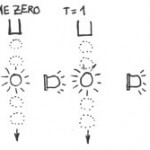
We start with a water stream or constant rate. Imagine we are able to detect drops of water falling, and we trigger a flash of light slightly after each drop is detected. If the drops are coming at a fast enough rate, we will see a shining drop of water suspended in mid air, in an otherwise dark area. We are obviously not seeing the same drop of water, but different drops of water that are "caught" by the flash of light at exactly the same position each time, giving the illusion that it is the same dropplet. Because we are triggering the flash events with the dropplets, the flash rate is equal to the dripping rate
, i.e., both will coincide at every time step.

Now, if we want to give the impression of time moving forward but in slow motion, all we have to do is record the time between drops and slightly increase it by a time delay for each consecutive drop. The time between flashes is then
, where n is each time step. That way each flash of light will show a droplet at a position slightly further down the path, giving the illusion of it falling down at slow rate.
Nate has done this using a trigger mechanism based on an OP AMP comparator circuit and an PIC microcontroller to provide the flash timing. Simply flashing the light in synch with the dripping water will "stop" time. And by altering the pulse frequency linearly (ramp like) will create the slowmotion, or even backward motion effects.
There is a shortcut.
Option #1
Start with a constant water dripping stream. Then blink really really fast. Ok, just kidding (or maybe not).
Option #2
Since we are not after the precise location of a given dropplet of water in space, we can forego the synchronization mechanism and just flash the light (LEDS in this case) at a constant rate. It doesn’t matter where in space we catch the dropplet, as long as we catch it consistently.
If the dripping rate is a multiple of the flashing rate, the flash of light will catch the droplets at the same position each time.
But what about slowmotion and backwards motion? Well it’s easy as too.
Imagine the drop rate is the same as the flash rate. Now we make the flash rate slightly slower, in other words we increase the time between flashes just a little bit: . The first drop will be caught at a certain point, but the next drop will be caught a point further down because we had some time left over from the previous flash. By adjusting the delay we can effectively change the rate of apparent fall. If the time between pulses is shortened we will catch the droplet at a higher position each time, giving the illusion of it moving backwards in time.
We have limited the discussion to a single flash of light during the whole length of the falling trajectory, but in practice, due to the periodic nature of the experiment, we will see at least two droplets of water along the path if we adjust the flash frequency to something other than the dripping rate. Usually the time it takes for a dropplet to fall all the way down is much larger than the time between drops, therefore we will see several dropplets suspended in mid air along the stream.
Now, how do we do this for real?
The simplest way to provide a series of pluses where we can control both the pulse duration and the frequency independently of each other: a 555 Timer chip and some LEDs.
The 555 circuit is used in an astable oscillator configuration but in an non-obvious way. If we just go ahead and build a traditional 555 oscilator circuit and try to adjust the frequency of the pulses, we will find that we will be adjusting the pulse width as well. If the pulse width, or pulse duration, is too long, instead of seeing a single droplet, we will see a streak of water, which is not very interesting since it is very similar to the way we are used to experience water streams.
Instead, we hook up the LEDs to the output and the +V so that we can fix the pulse width to a very short duration, and use the other resistor in the circuit to vary the frequency. Because the LEDs is ON for such a short period of time, we don’t even need a current limiting resistor, but I will leave that as optional in case you think you may burn out your LEDs (they do not burn for me, but do a test with 1 LED first).
Here is a version of the circuit which I have used and tested. You may want to add a transistor buffer at the output in case you have lots of LEDs. I tried 4 super bright white LEDs and they work fine without the need for a transistor buffer.
Lighting considerations
Shining light on transparent water has its own subtleties. Nate solved this by the use of UV LEDs and fluorecein, and it works fantastic. Luckily I had some fluorescent green dye stored in my lab. But there are other options.
Vegetable dye (food coloring dyes) work well, so does koolaid. These won’t need UV LEDS. Milk on a black background gives fantastic results and it is my favorite so far. Milk is organic so it will spoil and the smell won’t leave you any motivation for playing with the fountain. So we either innoculate cows with preservatives, or we can use certain varnishes and resins that look white when mixed with water. Whiteout or white paint is another option, we just need to make sure we add plenty of water to it so that it doesn’t clog the system.
If the liquid we use is semi-transparent the best lighting may probably come from either the side or the back, as can be appreciated in those gorgeous glassware product shots we are acustomed to seeing.
Frontal illumination at 45° from each side is probably the dullest (it’s the no shadow scheme used in TV studios).
Once I have some photos (tonight) I will post what the effect looks like. Also I have an idea for a simple rig with no motors needed.
The Drip Source
The best solution is possibly the use of a small fountain pump and some tubing. But if you want to make some quick tests, a simpler device may be used.
A container with a hole won’t work because the dripping will be very chaotic since the water will adhere to the walls of the container in an unpredictable way. This is easily fixed by gluing a piece of aquarium tubing to the container wall.
The best container is one that has a large surface area so that the water level changes slowly enough to be able to synch to the dripping rate. A bottle will not work as well. Also, the hole is better placed on the side wall (vertical wall) instead of on the bottom, and the tubing works best if held somewhat horizontal.
The hole in the container will need to be adjusted until the drip rate is fast but not too fast, so that the drops can be easily separated by the light flashes. I started with a small hole and expanded it with the tip of a pen until I got a good rate.